

Alumni Spotlight: Clarence Fluker, Association of American Medical Colleges
Posted in News Story Spotlight
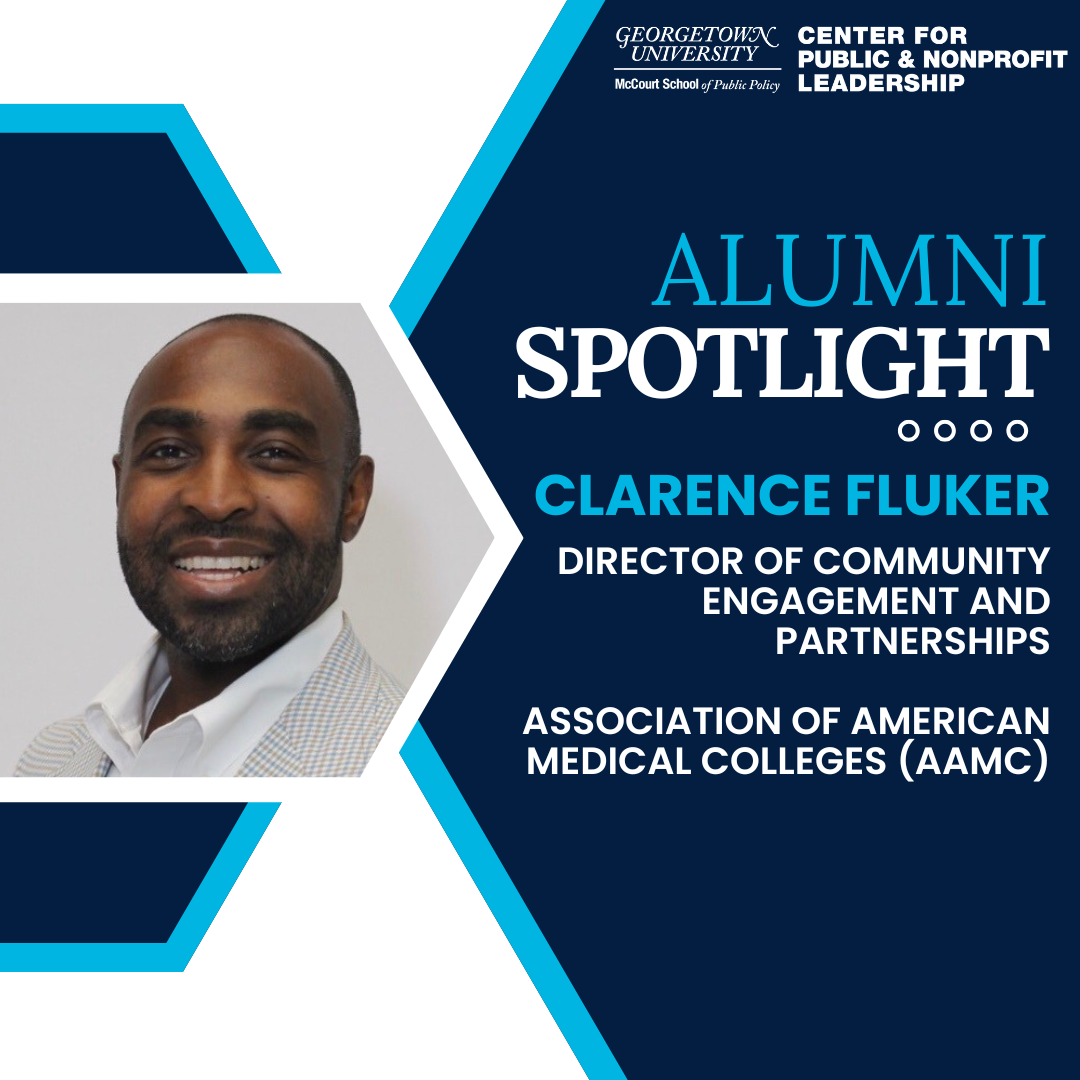
Clarence J. Fluker is the current Director of Community Engagement and Partnerships at the Association of American Medical Colleges (AAMC). The Center for Public and Nonprofit Leadership spoke with Clarence about the impact of the Executive Certificate in Philanthropic Leadership on his work.
Question #1: Please tell us a little bit about yourself.
Clarence Fluker: I am the Director of Community Engagement and Partnerships for the AAMC, the Association of American Medical Colleges, the voice of academic medicine in Washington, DC, representing medical schools and teaching hospitals. I have been in my role with AAMC for 8 years now, focused on community collaboration.
My portfolio includes philanthropy, volunteer engagement and community programs. Through our community grants program, we make awards to local nonprofit organizations working in the areas of healthcare and housing in Washington, DC. I lead our volunteer engagement program for 700-plus employees. I work to make sure that we are providing them with meaningful practical and skills based volunteer experiences that are aligned with our mission of improving the health of people everywhere. And the other leg of my work is leading partnerships and programming with local K-12 schools and local and national nonprofit organizations.
Prior to this, I held external relations roles in the Obama Administration, and before that I spent several years in local government working for the DC Mayor’s office doing community engagement, and before that, I worked at a series of nonprofits and a political action committee doing communications, fundraising and programs..
Question #2: What drove you to pursue a career in philanthropy, and how have you seen your philanthropic work impact the community?
Clarence Fluker: The word philanthropy itself, comes from the ancient Greek, “philo”, meaning to love or to be fond of, and “anthropos” which is humankind. The love of humankind is what philanthropy is at its core. And for me, I don’t think it’s just a career. It is an extension of how I want to live my life.
I grew up in East Cleveland, Ohio, to a single mom of three kids and while we did not have every material thing in the world, we had a lot of love. My mother instilled in us that it was important for us to share that love and to love our neighbors. She taught us that love and care are actions. From a very young age, I had the opportunity to volunteer alongside my mom and my siblings and to be exposed to what it means to invest in the community in different ways. Those early experiences serving food at shelters on holidays, spending time with elders in nursing homes, raising money for health related causes, and countless others, laid the foundations for my career.
The thread through all of my professional positions is that I have been working to help improve the lives of other people, and it has been rewarding in so many ways—to be able to see how investing in people, programs and research can help to transform the lives of individuals, families, and communities.
Question #3: What are some things that you enjoyed about the Executive Certificate in Philanthropic Leadership?
Clarence Fluker: A couple of the things that I enjoyed about the program were the faculty, who were able to connect philanthropy to policy and advocacy work in ways in which I think some in the sector do not always consider. I also enjoyed the insights from more seasoned and experienced philanthropic leaders who talked about how they navigated their career and their willingness to offer advice, guidance, and coaching on next steps.
Question #4: How would you like to see other organizations in your sector in the field, respond and work together during some of these challenging times?
Clarence Fluker: Policy touches all of our lives, and policy and appropriation shifts at the federal level means that we must do more strategic collaboration to help fill the gaps and do so in innovative ways locally and regionally. Recently I hosted a convening of health funders and leaders from local health departments to discuss the current and anticipated challenges that we see in our communities, and to talk about how both groups can work together to rise to meet those challenges.
In our region and across the nation I encourage organizations who are grant makers to one: use the full power of your resources, not just financial, to advance the mission and vision of your organization. And two: I encourage organizations in this field to lean into innovation, collaboration and education. The education piece is so important now because it is not just enough to tell the story of what you do and how you do it, we must also educate the public about the why. I believe that will help bring others along and support the work.
Question #5: With the challenges facing the sector, how do you remain motivated? And what advice would you give to people currently in the field who are also sort of feeling similar challenges and setbacks?
Clarence Fluker: In my role, I’ve had the privilege of being around and getting to know a lot of physicians and physician researchers over the last several years. I’ll say this, I think that there is a correlation between people who go into health and academic medicine, and the people who go into the philanthropic sector. That correlation is that you have two different types of professionals, dedicating their careers to a vision of a world where every person is able to live healthier lives, and to thrive. A researcher is in a lab trying to come up with a cure for an infection or a disease may not have found the right formula yesterday, but she’s coming back to doing research tomorrow because she believes that eventually she’s going to get it. And that there will be a cure, a treatment, or prevention. And the same thing is true, I think, for people in philanthropy. One grant cycle strategy is not going to undo a hundred years of a bad policy or underinvestment in a neighborhood or lack of concern about a societal issue that’s been ignored, right? But like the scientist, the program officer/grantmaker isn’t going to give up. They are going to continue working with community, experts and policymakers to come up with the right strategy to make the change they want to see. You have to keep going if you are committed to that mission, if you’re committed to the vision.
That is what keeps me going. The idea that maybe not today, but tomorrow, we can all live in a better, healthier world for all, and we’ve just got to keep going in order to get there. I owe that to the people who came before me and I owe that to the young people who are coming up behind me. You just have to keep on going. There is a cure. There is a solution. There is an intervention that’s going to work.
I know that we can live in a world with better health outcomes, where everyone is thriving, no matter their race, class, gender, or zip code. We can all be thriving.
My advice is to hold the vision, and look to the past and the people around you to remind you to keep going. If you believe in the promise of a healthier being, healthier families, healthier communities, a healthier country, a healthy world, you gotta keep going.The promise of that idea is what keeps me motivated and I encourage other people to think about it in the same way.
Question #6: How has your experience in the certificate program changed your approach to the work that you do? And what advice would you give to somebody who is considering applying?
Clarence Fluker: My advice to someone considering applying to the program is submit the application. The program offers a well-rounded understanding of the past, present, and future landscape of the philanthropic sector. In addition to the experienced leaders in the program’s faculty, you’ll really benefit from sharing knowledge in a cohort of professionals and leaders with different backgrounds, different points of view, different geographic perspectives, and different lengths of time in the sector.
There is a lot of learning going on in bidirectional ways, from participants to the faculty, participant to participant, and opportunities throughout the program for some introspective folks to also question and learn more about themselves.