

Alumni Spotlight: Collaboration between ASPIRE Afterschool Learning and Teach Peace of Mind
Posted in News Story Spotlight
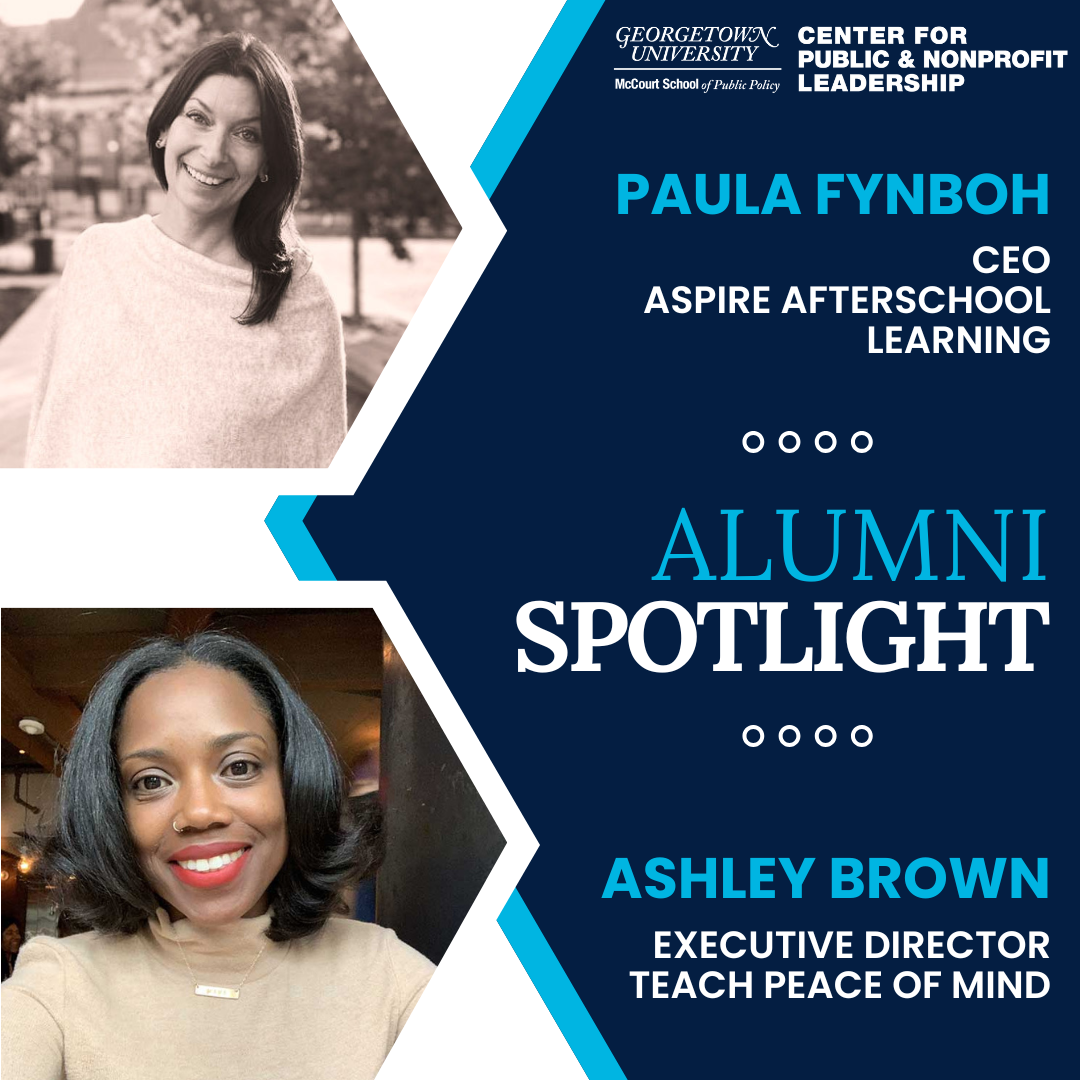
Paula Fynboh is the CEO of ASPIRE Afterschool Learning and Ashley Brown is the Executive Director at Teach Peace of Mind. After meeting during the Spring 2025 Nonprofit Management Executive Certificate Program, Paula and Ashley have decided to partner together. We sat down with them to speak about the impact of the program and what drives their motivation to work together.
Question # 1: What inspired you to do the work that you’re doing?
Paula: What inspired me to do this work is just a deep love and belief of young people and their potential. I want to make sure that all young people, regardless of income background, language, place of birth, race, ethnicity, have an equal chance to become everything that they want to be. And if that happens, we’re going to be able to create a better world, the kind of world that I dream of living in.
Ashley: For the last 14 years, I have been a high school teacher in DC. We’re really big on teaching kids, here’s how to do math. Here’s how to write an analysis. But we are not really big on teaching them how to manage their emotions and how to do the things that we ask them to do beyond academics. I think it’s important that we all take care of ourselves, but we don’t always have the tools. And that’s how I got here.
Question #2: What are the missions of your organization, and how did you find that they aligned in this collaboration?
Paula: Ashley and I were both in the Spring 2025 cohort of the Nonprofit Management Executive Certificate Program. We were just like, “Hey, let’s meet for coffee.” Then we started talking more about our work. ASPIRE’s mission is to close the educational opportunity gap. We have a focus on literacy, STEM, homework help, [and] project-based learning. But education is so relational, right? It’s so intertwined. We were doing social-emotional learning, but we weren’t measuring it. When Ashley talked about what she did at Teach Peace of Mind, I was like, oh, my God! We have to have that. Ashley came out to ASPIRE and trained all of our teachers in how to use the model. We piloted it over the summer and are kicking it off formally at the start of the program year. We’re all super excited about it!
Ashley: I will say that if I wasn’t doing this work that I’m doing, I would probably be starting an after school program because I just find it so critical that kids are in a space where they can learn: “How do I take care of myself emotionally? How do I build really positive and healthy relationships with people? How do I contribute to a more peaceful world?” Our mission to teach kids these things really aligned with ASPIRE.
Question #3: What are you hoping to achieve from this collaboration? Or how do you think the communities you serve will benefit from this collaboration?
Paula: I am a big believer in partnerships. I think we all do better when we all do better. And you know, we could have tried to take resources and staff capacity that we don’t have right now and create our own social, emotional learning curriculum. Or we could partner with somebody like Ashley, and Teach Peace of Mind, who’s knocking it out of the park. I have no doubt our kids are going to do better in school, and that our reading, and our STEM curriculum is gonna be even stronger and see greater results, because all of this is pouring into creating whole healthy kiddos.
Ashley: Yeah, I agree. I don’t think I have much to add. Paula said it beautifully.
Question #4: How has your experience in the Nonprofit Management Executive Certificate program changed or impacted how you both approach your work?
Ashley: Oh, my gosh! For me it’s been everything. I’m only 2 months into being Executive Director, so there’s a lot that I’m trying to figure out. I’m trying to take the things that I learned in the program, plus my intuition, plus my experience as a teacher, plus my experience and my love for students all over, and put all of those things together to really make sound decisions for our organization that get us to greater impact and lasting impact. The Certificate Program was wonderful for someone who is fresh in a leadership role like this.
Paula: I also think, in this role of Executive Director, sometimes it can be a lonely role. People are always coming to you to have the answers to solve the problems. We’re still human beings, and we don’t know all the answers. So this class, one, I think it just helped normalize what a lot of us are feeling. It was just such an opportunity, and really just a privilege to be able to learn from each other in different perspectives. I thought the coursework, the reading, the lectures, and the guest speakers were exceptional, but what made it even better was just all these people bringing their own selves, both professional and lived experience to this cohort, and the chance to learn from each other. I just thought that was exceptional.
Question #5: With all the challenges facing the nonprofit sector today, what keeps you motivated to do this work, and what keeps you going despite the challenges and setbacks that you face?
Paula: I just don’t see that we have a choice. I was telling somebody else this today. My husband worked for USAID and his job ended on April 20th. On April 28th, a bunch of our federal funding was cut, and it sucked. I think it’s going to be a rough 4 years for us. I also think my husband and I have enjoyed enough privilege that maybe we’re not going to be in a good place in 4 years, but we’re going to be standing. Unfortunately, I don’t think that’s going to be true for some of the families and the kids that we serve, and I just think there’s no other choice but to show up for them right now.
Unfortunately, it feels like we’re in a bit of a leadership vacuum of people having the moral courage to do what is hard. It’s got to come from somebody. So why not us?
Ashley: For me, it’s just remembering that it is bigger than me. When I start to think that, I’m tired, and it’s time for me to quit. Then I’ve lost the plot. It’s about being a part of this movement. And hopefully, this lasting change to prioritize what’s important—building community and building healthy relationships. I just try to keep in my mind that this is bigger than me, and it’s really not about me. I’m just here being the vessel.
Paula: I think one of the privileges of holding a leadership position is being able to set a different tone and a different culture and a different way of working. And, you know, acknowledge ways of working in the past that just aren’t serving us anymore. The success and the impact that we have because we’re leading with joy. Our kids get to experience joy and hope in a world that right now feels pretty lacking in both of those things.